
Confidence Is a Skill, Not a Personality Trait
Building Braver Dogs, Part 2

Ask someone what every dog should know, and you'll probably hear the same answers.
Sit. Stay. Come.
There's no question these cues matter. A reliable recall can save a dog's life. A solid stay makes everyday situations easier. Basic obedience gives us a common language to communicate with our dogs.
But if I could choose just one thing for every dog to have, it wouldn't be a perfect sit.
It would be confidence.
A confident dog is better equipped for life
Life doesn't happen in neat little training sessions.
It happens when a garbage truck rumbles past your house. When the veterinarian enters the exam room. When your dog meets a person wearing a big hat for the first time. When the floor changes from carpet to shiny tile. When you're hiking and suddenly come to a narrow bridge.
These aren't obedience problems. They're confidence problems.
A dog who believes they can handle new experiences is far more likely to recover from surprises than a dog who's only practiced commands in familiar settings.
Confidence creates choices
Fear changes how dogs think.
When a dog is frightened, they're not trying to be stubborn or disobedient. Their brain is focused on one thing: staying safe. That often leaves them with a limited menu of responses.
Run away. Freeze. Bark. Lunge. Hide.
Those behaviors aren't signs of a "bad" dog. They're survival strategies.
Confidence gives dogs another option. Instead of immediately reacting, a confident dog is more likely to pause, gather information, and discover that the situation isn't actually dangerous.
That moment of curiosity is where learning happens.
Obedience doesn't always equal confidence
We've all met the dog who can perform every command in the backyard but falls apart somewhere new. They know sit. They know down. But take them to a busy park, and suddenly it's as if they've forgotten everything.
Usually, they haven't forgotten. They're overwhelmed.
When a dog is over their comfort threshold, learning takes a back seat to survival. That's why simply asking for more obedience doesn't solve fear.
Helping a dog feel capable does.
What confidence looks like
Confidence isn't loud. It isn't bold. And it certainly isn't fearless.
A confident dog might:
Walk across an unfamiliar surface after taking a moment to investigate
Recover quickly after hearing a loud noise
Choose to approach something new instead of immediately retreating
Look to their person for guidance instead of panicking
Bounce back after being startled
Notice that none of these have anything to do with perfect obedience. They're life skills.
Confidence changes everything
When Gus first began working on confidence, strangers were hard. New places were hard. Unexpected situations were hard.
We could have spent every training session asking him to sit. Instead, we spent time helping him discover that the world wasn't as scary as he thought.
We celebrated tiny victories. Walking across a new surface. Climbing onto a low platform. Even walking on a treadmill, which he did not care for.
Little by little, those experiences added up.
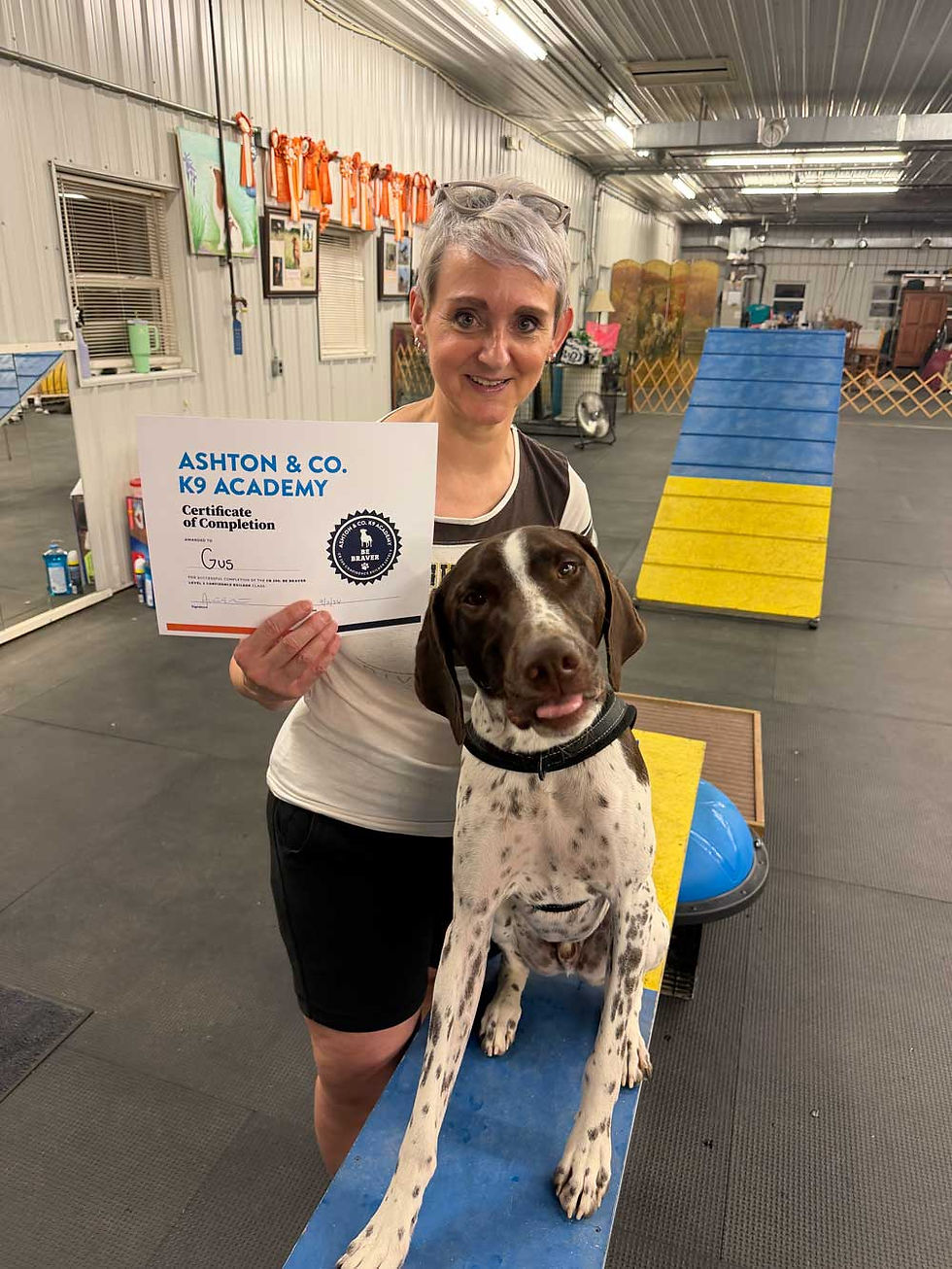
Gus just finished — and graduated from — Be Braver, our Level 2 Confidence Builder class. It was a small group, just four dogs, and what struck me most was how calm they all were around one another. No pinballing energy, no tension. Just four dogs quietly figuring out how to be brave together.
Watching Gus in that room, it was hard to remember how worried I'd been about his fear reactivity going in. By the end of class, it simply wasn't an issue anymore.
Recently, Gus met several new people while we were on vacation. A year ago, that would have been unthinkable. This time, he greeted them calmly and moved on with his day.
He didn't change overnight. He built confidence one small success at a time.
Real-world test
Last week, we had an opportunity to put his training to the test in a real‑world situation.
We’d just sat down to watch the next episode of the show we were currently binging, Cardinal, when my phone blasted a very loud, very insistent alarm. A line of dangerous storms was moving through the area, conditions were perfect for tornado development, and we were instructed to take shelter in a basement or any safe interior room.
We didn’t bother turning off the TV; we just headed straight for the basement steps.
Our house is old — built in 1937 — and the basement stairs are … well, they’re not friendly. They’re steep, narrow, and open‑backed.
The last time we had to take shelter, Gus was younger and much smaller. We could scoop him up and carry him down. Not anymore. This time, he had to walk the stairs himself, and he was decidedly not a fan of the plan.
So we treated it like an obstacle from our Be Braver class: slow approach, lots of encouragement, praise for tiny wins, and a jackpot of treats at the bottom. The first few steps were tough, but once he realized the stairs weren’t going to swallow him whole, he headed down like a pro.
That’s a huge win — and in an emergency, it can be the difference between a dog who gets rescued and a dog who doesn’t.
The goal isn't a perfect dog
Sometimes we put so much pressure on ourselves to have a "well-trained" dog that we forget what our dogs actually need from us.
Most dogs don't need to impress anyone with flawless obedience. They need to feel safe. They need to trust us. And they need opportunities to discover that they're capable of doing hard things.
That's what confidence building is all about.
Not creating fearless dogs.
Creating dogs who know they can handle whatever life puts in front of them.
And dogs who are confident enough to show how they really feel about it. #ClassicGus
Coming up next
In the next article, we'll take a closer look at what's actually happening inside a fearful dog's brain — and why understanding fear is the first step toward helping dogs become braver.
Thanks for following along on our adventures. My Barking Life exists to help more dogs stay with the families who love them by sharing stories, practical tips, and a little inspiration along the way. I hope this post encourages you and your dog to discover a new adventure together.


Comments