
The Australian Shepherd
They're always up for an adventure. The question is ... are you?
What's Breed Got to Do With It: Vol. 16

If you’ve ever lived with an Australian Shepherd, you already know this — they’re watching you.
Not in a creepy way, but in an I-have-a-full‑time-job-and-that-job-is-monitoring-you-and-the-universe way. The sound of the refrigerator opening. The squirrel that moved three houses away. The fact that you didn't put your shoes on yesterday but did today. The other dog across the street. The kid running down the sidewalk. The toy you just picked up. Your existential state.
And now they’re watching you wonder why they’re watching you.
Welcome to life with an Aussie.
Australian Shepherds are gorgeous, athletic, brilliant, loyal, and wildly capable. They can be phenomenal companions, working partners, sport dogs, service dogs, and general overachievers.
They can also be … a lot.
And that's something worth understanding before you bring one home.
First Things First: They're Not Australian
Despite the name, the Australian Shepherd is not from Australia. Not even a little. The confusion comes from a historical game of telephone in the 1800s, when American ranchers were importing Australian Merino sheep — prized for their wool — to the western United States. Those sheep arrived at West Coast ports, frequently accompanied by herding dogs or joined by them once they reached ranches in California and the Pacific Northwest.
To the ranchers, the math seemed simple: Australian sheep + herding dogs = Australian Shepherds.
In reality, many of the dogs who shaped the breed came with Basque shepherds who had traveled through Australia or worked alongside Australian stock before arriving in the U.S. The dogs weren’t Australian; they were just associated with Australia because of the sheep trade.
Along the way, the breed also became closely associated with rodeo culture. Aussies weren't just pretty dogs standing beside cowboys; they were working partners capable of moving livestock, learning complicated tasks, and making decisions in the middle of a job.
That history matters because it still shows up in modern homes. When you look at the Australian Shepherd sitting on your living room floor, you're looking at a dog whose ancestors were expected to get up and go to work all day, every day.
Herd, Chef
Aussies belong to the AKC Herding Group, which tells you almost everything you need to know about their instincts. Herding dogs notice movement, respond to movement, and sometimes try to manage movement. You can’t train out DNA, but you can manage it.
Expect a dog who:
watches everything
learns fast
anticipates patterns
tries to help, even when you didn’t ask
Because smart doesn’t mean easy. Sometimes smart means your dog is already three steps ahead of you.
Energy, Brain, and the Off-Switch
People hear that an Australian Shepherd needs lots of exercise and think: "Great. I'll take him for a long walk."
And that's certainly better than no exercise.
But Aussies need more than physical exercise — they need work for their brain. Their original job required attention, interpretation, decision‑making, and stamina. A long walk is lovely, but it won’t touch the mental energy this breed carries.
Good outlets include:
obedience
agility
scent work
trick training
structured play
food puzzles
Something else to keep in mind: Your Australian Shepherd doesn't necessarily distinguish between the things you meant to teach and the things you accidentally taught.
You open the baby gate the same way every day? He notices.
You reach for the treat jar before you ask for a behavior? She notices.
You let him bark at the mail carrier because you're too busy to deal with it? Oh, he noticed that one. And once an Aussie figures out that something gets a reaction or response from you, good luck convincing him otherwise.
So, perhaps the most surprising thing about living with this breed is knowing that you may need to teach an Aussie how to do nothing.
For some dogs, couch-potato-mode comes pre-programmed. But for many Australian Shepherds, settling is a skill they need to learn.
That's not necessarily a flaw. Think about what we have bred this dog to do. For decades, we've selected for attentiveness, responsiveness, energy, stamina, and a willingness to work.
Now we're asking that same dog to spend eight hours hanging out in the house while we work from home.
There can be a real disconnect there.
Aussies need to learn that there are times to work and times to relax.
That means rewarding calm behavior. Teaching place or mat work. Building duration gradually. Creating predictable routines. And making sure the dog gets enough appropriate activity without turning every waking moment into an opportunity for more excitement.
Because if every time your dog gets restless you respond by making the activity bigger, faster, and more exciting, you may accidentally teach your dog that restlessness is how you get the party started.
Sometimes the most valuable thing you can teach an Aussie is: "We're done. Go lie down."
Herding the Household
Aussies herd. Not because they’re bossy (athough, sometimes, yeah), but because generations of selective breeding told them movement is their business.
Running kids? Interesting.
Running dogs? Very interesting.
Squirrels? Obviously.
Someone heading toward the door? Absolutely must intervene.
Nipping at heels, chasing, barking, blocking movement, or becoming overly focused on moving people or animals are not behaviors that should be shrugged off as "cute Aussie stuff." They're behaviors that need to be understood and managed before they become a genuine problem.
And this is another reason breed knowledge matters. If you understand why your dog is doing something, you're much more likely to teach an appropriate alternative instead of simply punishing the behavior.
Training
If you enjoy training, an Aussie is a dream. If you don’t enjoy training, an Aussie will teach you to enjoy training out of necessity.
Training isn’t a weekly event — it’s woven into daily life:
at the door
on walks
meeting new people
when your dog wants something
when your dog is excited or frustrated
Consistency matters. If something works once, your Aussie will assume it’s worth trying again.
Grooming: Prepare for the Fur
That gorgeous Aussie coat isn't self-cleaning.
Australian Shepherds have a medium-length double coat and they shed. A lot.
There's an old joke that Australian Shepherds shed twice a year ... for six months at a time.
It’s not wrong.
Regular brushing helps. Routine care helps.
Finding fur in places you didn’t know existed is simply part of the package.
Health
Like every breed, Aussies have health concerns that prospective owners should understand.
The Australian Shepherd Club of America's breeder code of ethics specifically calls for hip evaluation and eye examinations in breeding dogs. Responsible breeders follow the guidelines. But we know that not all breeders are responsible, so do your research before putting down a deposit.
The breed also has a known association with the MDR1 gene mutation, which can make affected dogs unusually sensitive to certain medications. Seizures and epilepsy are genuine concerns.
This is one of those places where I always want to emphasize the same thing — health testing is important, but it's not a crystal ball.
A breeder can make responsible choices and still produce a dog that develops a health problem. Conversely, a shelter dog with an unknown background can live a long, healthy life.
Either way, veterinary care is part of the cost of having a dog.
What Does an Australian Shepherd Cost?
Let’s talk money — not because it’s fun, but because it’s part of keeping dogs in homes. An Australian Shepherd isn’t the most expensive breed out there, but they’re not a “budget dog,” either. They’re a high‑engagement breed, and high engagement tends to come with high upkeep.
Upfront Cost: Breeder
A responsibly bred Australian Shepherd from a reputable breeder typically runs $1,000–$2,500 depending on:
pedigree and titles
health testing
coat color (yes, merle inflation is real)
breeder reputation
region
Aussies from working‑line breeders and sport breeders may fall on the higher end because those programs invest heavily in health, temperament, and performance.
And just to be clear: “responsible breeder” means health testing, contracts, lifetime support, and zero tolerance for cutting corners — not “someone who had a pretty dog and thought puppies sounded fun.”
Upfront Cost: Rescue
Adoption fees for Aussies and Aussie mixes in Ohio rescues and shelters usually fall between $150–$450, depending on age, medical needs, and the organization.
This often includes spay/neuter, vaccinations, microchip, and basic vetting — a genuinely good deal, especially for a breed that tends to land in shelters when people realize they adopted a full‑time job.
Long‑Term Cost of Owning an Aussie
This is where the numbers matter most. Aussies are active, intelligent, athletic dogs, which means they come with ongoing expenses that reflect that lifestyle.
Typical annual costs:
Food: $600–$900 (more if you have a large male or a sport dog)
Routine vet care: $300–$600
Emergency vet care: unpredictable, but realistically $500–$2,000+
Training classes: $150–$300 per course
Dog sports or enrichment activities: $200–$1,000 annually depending on your level
Grooming supplies: $100–$200 (they shed like it’s their job)
Pet insurance: $600–$900 annually
Replacement of toys destroyed by enthusiasm: ongoing, spiritually expensive
Aussies are also one of those breeds where pet insurance is genuinely worth considering, simply because athletic dogs sometimes … do athletic things that require orthopedic surgery.
What About Aussie Mixes?
This is particularly important when you're looking at shelter dogs.
An Australian Shepherd mix may absolutely inherit some of the breed's characteristic traits. But "mix" does not automatically mean "easier." A dog who is half Australian Shepherd and half another high-drive breed may have more energy and drive, not less.
And even if the other half is a relatively easygoing breed, genetics don't come with a neat little calculator that says: 50% Aussie = 50% Aussie behavior.
Every individual dog is an individual.
That's why I would much rather see someone meet a shelter or rescue dog in person and learn about that particular dog rather than make assumptions based solely on a breed label.
The breed gives you clues, but the dog gives you the answers.
Myth-Busting the Aussie
"They're smart, so they're easy."
Nope.
They're smart. That's different. A smart dog can learn what you want very quickly. A smart dog can also learn what you don't want very quickly.
"If I exercise them enough, they'll be fine."
Not necessarily.
Exercise is important. But mental stimulation, training, and the ability to settle are equally important pieces of the puzzle.
"They need a huge yard."
A huge yard can be nice, but it's not a substitute for interaction. A bored Aussie in a huge yard is still a bored Aussie.
"Aussies are great family dogs."
They absolutely can be. But "family dog" doesn't mean "easy dog."
Children running, screaming, and playing can activate herding instincts. Other pets can become targets for chasing or controlling. A family needs to be prepared to teach the dog appropriate behavior and supervise interactions.
"An Aussie mix will be easier."
Maybe. Maybe not.
The individual dog matters far more than the word "mix" on a kennel card.
So ... Is an Australian Shepherd Right For You?
If you've read one of these posts before, you know that this is the point in the post where I send you away to do some work.
The American Kennel Club has a Dog Breed Selector quiz designed to match your lifestyle and preferences with breeds that may be a good fit. Take it.
But here's the important part: Answer honestly. Don't answer the questions based on the dog you wish you had. Answer based on the life you actually live.
Do you have time every day for exercise and training?
How much shedding can you tolerate?
How much energy do you realistically want to deal with?
How much time will the dog spend alone?
Are you prepared for the adolescent stage?
Can you afford routine veterinary care and an unexpected $2,000, $4,000 or $6,000 veterinary bill if something goes wrong?
Are you looking for a dog who will happily spend most of the day lying beside you?
Or are you looking for a dog who would really prefer to know what we're doing next?
There is no wrong answer.
The goal isn't to get the breed you want. The goal is to find the breed that fits the life you actually have.
And if the Australian Shepherd comes back as a match? Wonderful! Now you know what you're signing up for.
TAKE THE QUIZ
Curious about whether an Australian Shepherd actually fits your lifestyle? Wondering if another breed might be a better match for your household? The AKC's Dog Breed Selector quiz is a genuinely useful starting point before you fall in love with a face at the shelter or add your name to a breeder list. akc.org/breed-selector-tool
About Those Dogs in Shelters ...
I've been looking at Aussies and Aussie mixes available for adoption in my area, and there are a lot of them. That's not surprising to me anymore. Because when you combine a beautiful appearance with an enormous amount of intelligence, energy, trainability, and personality, you have a dog that is incredibly appealing.
But you also have a dog that can overwhelm an unprepared household.
That doesn't make the dog bad. It doesn't make the breed bad. And it doesn't mean every Australian Shepherd in a shelter was surrendered because somebody "couldn't handle" it. Dogs end up in shelters for all kinds of reasons.
But when you see an Aussie or Aussie mix waiting for a home, I hope you'll look past the pretty face and ask a different question:
What kind of life does this dog need?
Not just:
How badly do I want this dog?
Here are a few Aussies worth checking out. Click on the dog's image to see their Petfinder profile.

Lyle
Age: Puppy (less than a year)
Sex: Male
Size: Medium (26–60 lbs.)
Vaccinated: Yes
Available through The Road Home Animal Project in St. Clairsville, OH.

Calypso
Age: Adult (3-8 years)
Sex: Male
Size: Medium (26–60 lbs.)
Vaccinated: Yes
Available through The Road Home Animal Project in St. Clairsville, OH.
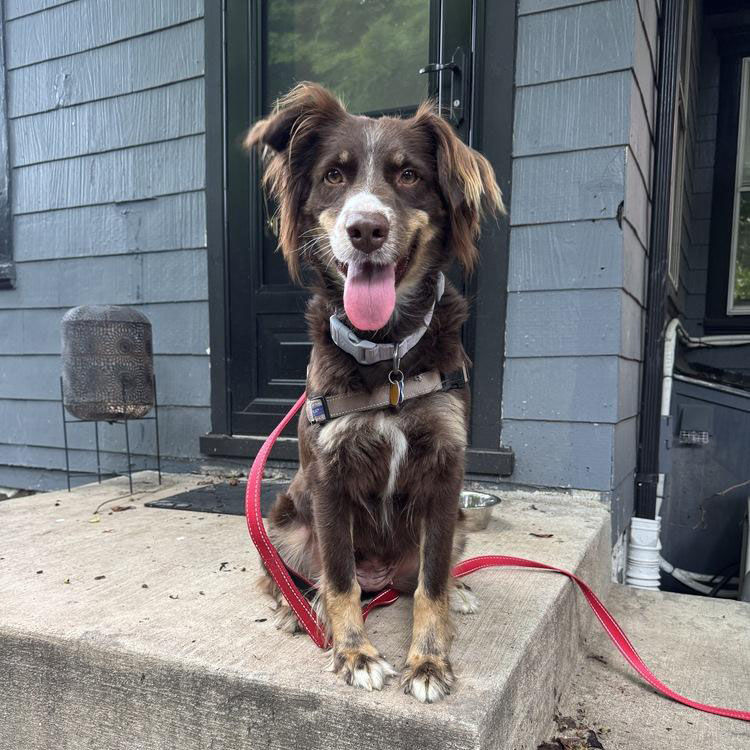
Chassis
Age: Adult (3-8 years)
Sex: Female
Size: Large (61–100 lbs.)
Vaccinated: Yes
Available through RescuedOhio in New Albany, OH.
Don't miss a single bark.
What's Breed Got to Do With It is part of our ongoing series on breed realities, adoption advocacy, and finding the right fit. It drops right here on the Bark Blog every Thursday.
If you want more MBL updates delivered straight to your inbox, subscribe to Bark Bits, the My Barking Life free weekly email newsletter.
My Barking Life is an animal-themed art and advocacy brand based in Ohio. Follow along at mybarkinglife.com and on Instagram, Threads, Facebook, and Pinterest.


Comments