
The Dog I Didn't Like — And Why I'll Never Stop Fighting for Him
Updated: Aug 1


My brain has maintained a mental image of Pike from his first night home. He's tiny and ridiculous-looking, all ears and legs, climbing up our staircase at 2 a.m. like he owned the place.
He was supposed to be in his pen. In his crate. On the first floor.
He was eight weeks old, and he had already escaped.
That was the beginning.
The Dog We Almost Didn't Get
Let me back up.
Years before Pike came into our lives, my partner Ted and I were looking for our first dog. Ted had always wanted a Vizsla — a lean, athletic breed built for people who run, and run a lot. We did our research, found some breeders, and were proceeding with the process, days away from adding our name to a waiting list or two.
But then a weird thing happened. We were at a race in the woods in the middle of nowhere when I spotted a woman with one at her side.
I struck up a conversation. Her name was also Kim, which felt like a sign. Her Vizsla was beautiful.
"As long as we take her for at least a two-hour run every day," she told me, "we don't have any trouble."
Two hours. Every day. I told Ted about the conversation on the drive home. We looked at each other and quietly closed that chapter. We didn't have that kind of time or energy, and we knew it.
So we got the dog *I* wanted — a French Bulldog. Problem solved.
Then Covid happened.
We were both home. Ted had always wanted a dog he could run with, and suddenly we had more time than we'd ever had. We started looking for a puppy — something high energy, something Ted could really bond with through running.
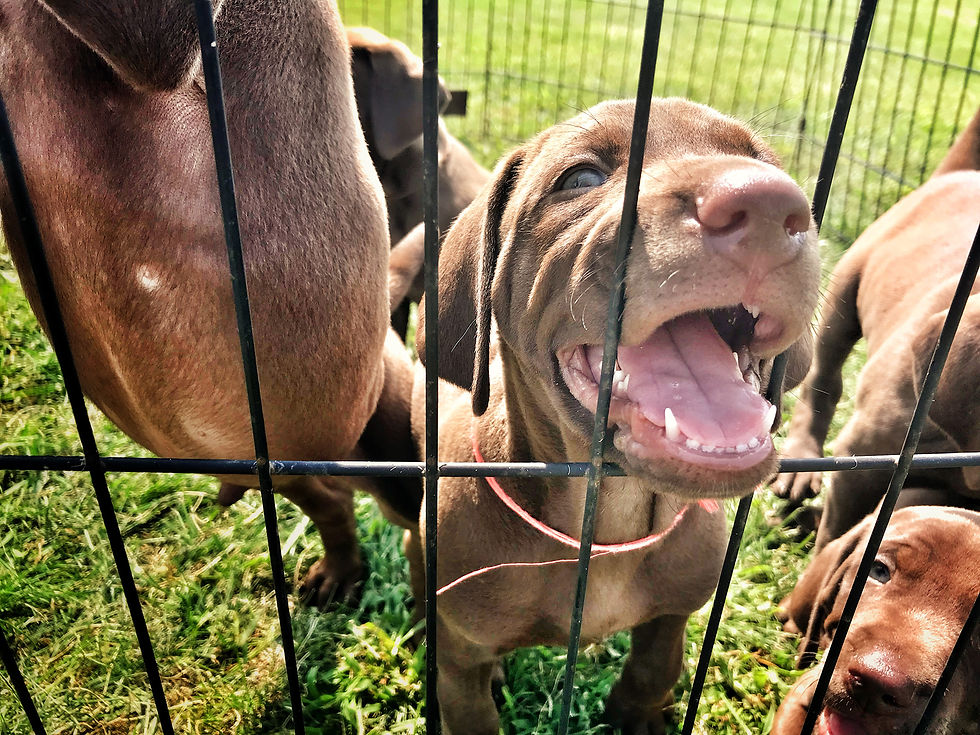
We found a breeder with Weizsla puppies — a Vizsla/Weimaraner mix. The thinking, we were told, was that blending the two breeds would cancel out the more extreme traits of each and produce a calmer, more manageable dog.
Reader, it did not.
The Tasmanian Devil Years
Pike came home and immediately set about dismantling our lives in the most creative ways possible.

He stole and ate our Thanksgiving pumpkin roll. Tub of butter? Delicious! He managed to swipe three bananas from the kitchen island, took them to his crate, and devoured them — peels and all — but left the stems, as if even he had some standards.
He barked at everything. He lunged at anything that moved. Kids on bikes. People on motorcycles. Bunnies and birds with the audacity to exist in his vicinity.

He was big. He was strong. And I was the one home with him every single day while Ted went to work.
The moment I knew we were in real trouble happened on an ordinary afternoon walk near our local park. A loud motorcycle went by, and Pike lost his mind completely. Spinning, thrashing, barking, lunging — a full Tasmanian Devil in a dog harness. I held on with everything I had, and when it was over I stood there on the sidewalk shaking, realizing that I genuinely didn't know what I would do if I lost my grip on that leash. The motorcycle, the cyclist — someone could get seriously hurt. Maybe Pike. Maybe someone else.
He was almost a year old, and I was already thinking about surrender.
I'm not a quitter. I don't like giving up, and I really don't like admitting mistakes. But the truth — the honest, uncomfortable truth that I don't like to talk about much — is that I didn't like my dog. I didn't hate him, but I had a very intense dislike for him. He had turned my daily life into something I was just trying to survive.
Ted would come home, take Pike for a walk, and get a small taste of the chaos. But he left every morning. I didn't. The weight of Pike's issues fell almost entirely on me, and it was lonely and exhausting in a way that's hard to describe.
We tried. We really tried.
We sent him to a board and train program for two weeks. I had enormous hopes for it — *enormous.* And when he came back, he was a little better. But here's what nobody tells you about board and train programs: your dog learns from the trainer, and then comes home to people who don't know how to communicate with him the same way. One recap session isn't enough to transfer those skills. Pike did well for the trainer. He fell apart for us, because we didn't have the tools to maintain what he'd learned.

The thing that kept me going, honestly, was a doggy daycare that opened down the road. Twice a week, he was someone else's problem, and I could breathe. It wasn't a solution. It wasn't even close to a solution. But it was survival.
One day, I asked the woman at the front desk — who Pike had literally just dragged from the back of the building — if she knew any good dog trainers in the area.
She gave me the name of the woman who changed our lives.
Sixty Seconds in the Park
I called Ashton from Ashton & Co. K9 Academy, gave her the overview, and tried to keep the desperation out of my voice. She recommended one-on-one training and suggested we meet at our local park — lots of distractions, real-world conditions, exactly the environment where Pike fell apart.

Side note: Our first session had to be delayed because a few days prior, Pike attended a pool party and managed to rip the skin off the pads of his feet, rendering him unable to move. We had to take him to an emergency vet clinic — on the weekend — where they treated and wrapped his feet and sent us on our way with a wallet that was MUCH lighter and looking like this (see ridiculous photo above). He had the wrappings off one paw before we got home, and ALL of the wrappings off within two hours of getting home. A week later, we were healed and ready to start on our new life-changing training journey.
Within the first minute of our meeting, Ashton pulled out a prong collar.
If you've never seen one, a prong collar is a medieval-looking thing — a chain of metal links with blunted prongs that sit against the dog's neck. My stomach dropped. Every instinct I had said to load Pike back in the car and leave.
But I had no other options. It was this, or lose my dog. And even though I didn't particularly like him at that point, I wasn't ready to give up on him.
She put the collar on him.
I am not exaggerating when I tell you that he immediately became a different dog.
No pulling. No lunging. No spinning. We walked all around that park — past people, past distractions, past all the things that usually sent him into orbit — and he walked beside me like a dog who knew exactly what was expected of him.
It was the first time in almost two years that I felt something I hadn't felt in a long time.
Hope.
The Long Road to a Good Dog
It wasn't a fairy tale from there. There were still hard weeks and harder sessions.
During one of our one-on-ones, Ashton brought in another student and her dog — something she does often, pairing a solid dog with a struggling one to build confidence and exposure. Pike was a barking lunatic that day. The other woman, who is now a good friend, was visibly terrified of him. I understood. He *sounds* vicious, even when he isn't.

After our one-on-one sessions wrapped up, we had a better dog. Not a good dog yet. Just better.
The real breakthrough came when I stopped taking him to daycare.
I had noticed that Pike was doing beautifully in the days after class — calm, responsive, manageable. But then he'd go to daycare and come home like the old Pike, wild-eyed and reactive. I mentioned it to Ashton, and she explained it so clearly that it changed the way I understood everything we'd been doing.
When Pike is with us, we require impulse control. If he lunges at a car or a bunny, there's a correction. He learns that his impulses have consequences. But at daycare, he was free to act on every impulse without any structure or consequence. The two environments were sending him completely opposite messages, and it was genuinely confusing to his brain.
I stopped taking him to daycare. And that was the last piece of the puzzle.
The Dog He Is Now
Pike turns five this summer. He is currently enrolled in Be Brave, a Level 1 Confidence Building class, and he'll move into Be Braver in June. He will keep taking classes for as long as he's able, because that's what works for him and for us.

He is my best buddy. I adore him in a way that still catches me off guard sometimes, because I remember so clearly how I felt about him in those early years. He chooses to snuggle with me on the couch every single night. If Gus — our younger German Shorthaired Pointer — is already in his spot, Pike will push him out of the way without a second thought, and settle in like the senior statesman he is.
He is an AKC Canine Good Citizen. The dog who once sent a park full of people scattering is now certified by the American Kennel Club as a model of good behavior.
It's so hard to believe that the monster I had is the sweetheart I have now.
Why I'm Telling You This
I'm telling you this because I know you might be in the middle of your own version of this story right now. Maybe you have a dog you're struggling to like.
Maybe you've tried things that haven't worked. Maybe you're sitting with a quiet shame about how close you've come to giving up.

I want you to know: I've been there. And it gets better. But it gets better with the right help.
Training isn't just about having a well-behaved dog — though that's a wonderful thing. It's about building a relationship between you and your dog that is built on trust and communication. It saved Pike's life. It saved our bond. And it transformed a dog I didn't like into a dog I cannot imagine my life without.
If you're ready to start that journey and you live in central Ohio, Ashton & Co. K9 Academy has summer classes beginning in June. Enroll here.
And if cost is a barrier, please don't let it stop you. The Training Assistance Grant (TAG) covers the cost of the Foundations First course for dogs and owners who qualify. You have nothing to lose and everything to gain. Apply here.
Every dog deserves a chance. Pike is proof of that.
Thanks for following along on our adventures. My Barking Life exists to help more dogs stay with the families who love them by sharing stories, practical tips, and a little inspiration along the way. I hope this post encourages you and your dog to discover a new adventure together.


What a beautiful story. You all each saved each other with love!❤️
🥹🥹🥹🥹